
What is PWM? A Complete Beginner-to-Advanced Guide to Pulse Width Modulation (With Examples)
If you have ever controlled the speed of a DC motor using an Arduino Nano, dimmed an LED, or built a drone ESC system, you have already used PWM — Pulse Width Modulation — even if you didn't realize it.
But what exactly is PWM? Why is it so powerful in electronics, robotics, drones, and power systems? And how is it different from PPM? This guide explains PWM definition, history, working principle, generation methods, key parameters, types, comparison with PPM, applications, advantages, and disadvantages — in a clear flow that makes sense even if you are just starting.
What is PWM (Pulse Width Modulation)?
PWM (Pulse Width Modulation) is a technique used to control power delivered to an electrical device by switching the supply voltage ON and OFF at a very high speed.
Let's break this down word by word:
- 1Pulse → A signal that turns ON and OFF.
- 2Width → The amount of time the signal stays ON.
- 3Modulation → Changing or controlling something.
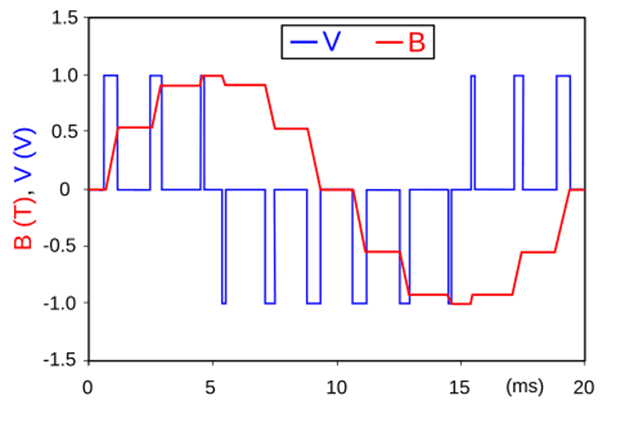
PWM means controlling power by changing the ON-time of a repeating signal. Instead of reducing voltage like a variable resistor (which wastes energy), PWM rapidly switches between 0V and full voltage, and controls how long it stays ON in each cycle.
A Simple Real-Life Example
Imagine you are switching a bulb ON and OFF 1000 times per second:
- 1If it stays ON for 90% of the time → It looks bright.
- 2If it stays ON for 20% of the time → It looks dim.
Even though the voltage is always full (like 12V), the average voltage changes depending on ON time. That average effect is what controls:
- 1LED brightness
- 2Motor speed
- 3Fan speed
- 4Heating systems
- 5Drone ESC throttle
History of PWM
PWM concepts began appearing in the early 20th century with radio transmission systems. However, PWM became widely practical in the 1960s–1970s when power electronics advanced.
With the invention of switching transistors like the MOSFET and later the development of integrated timer ICs such as the 555 timer IC, PWM became easy to generate. Modern microcontrollers like Arduino Uno, ESP32, and STM32 have built-in PWM modules, making it extremely common in embedded systems.
Switching power supplies, Motor drivers, Solar charge controllers, Drone ESCs, and UPS systems.
Principle of PWM (How It Works)
PWM works on the principle of average voltage control using duty cycle variation. Let's define the important terms clearly.
1. Duty Cycle
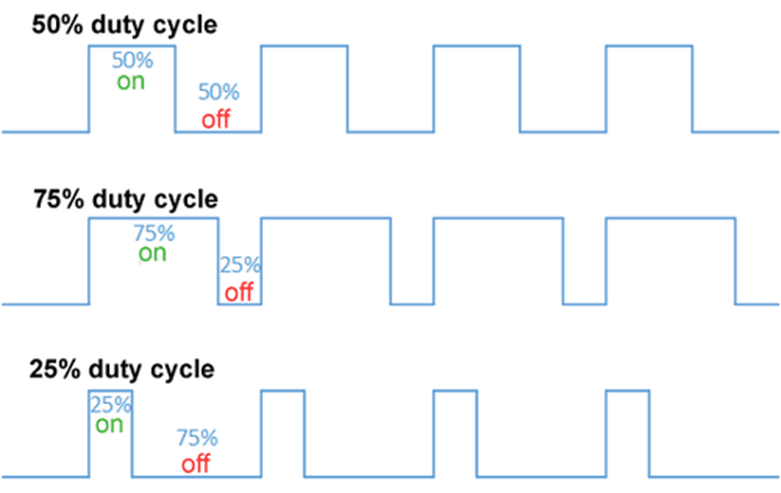
The duty cycle is the fraction of time that a signal is ON during one complete cycle. It is expressed as a percentage.
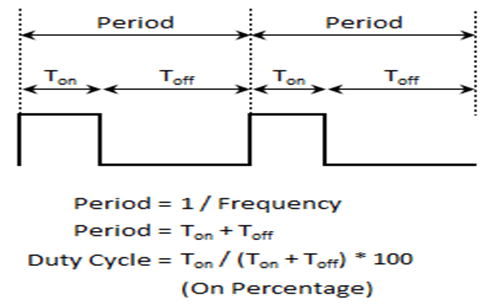
Duty Cycle (%) = (ON time / Total Time) × 100
Example: If total period = 10ms and ON time = 5ms → Duty Cycle = 50%
That means average voltage = Supply Voltage × Duty Cycle. If supply = 12V and duty cycle = 50% → Average voltage = 6V. This is how PWM controls output without reducing actual voltage.
2. Frequency
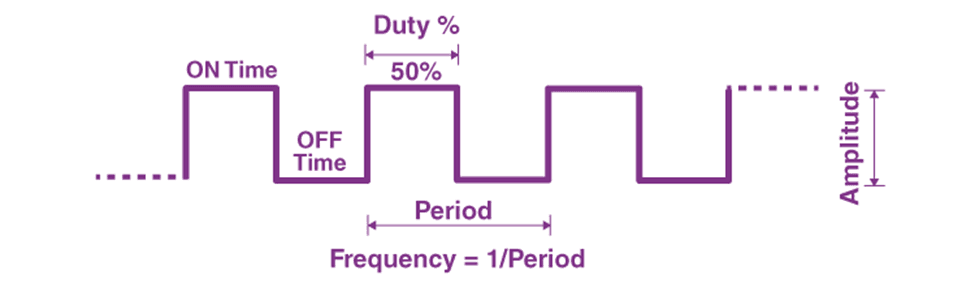
Frequency is how many times the pulse repeats per second. It is measured in Hertz (Hz). High frequency makes output smoother, especially for motors and audio systems.
- 11 kHz = 1,000 cycles per second
- 220 kHz = 20,000 cycles per second
3. Period
Period is the total time of one complete ON-OFF cycle. It is the inverse of frequency.
Period = 1 / Frequency — Example: If frequency = 1 kHz → Period = 1/1000 = 1 ms
How PWM is Generated
PWM can be generated in multiple ways depending on the application and complexity required.
1. Using 555 Timer IC
The 555 timer IC configured in astable mode produces PWM. By adjusting resistor and capacitor values, you can change frequency and duty cycle.
Simple LED dimmer and small motor control circuits.
2. Using Microcontrollers
Modern microcontrollers like Arduino Nano and ESP32 contain internal timers that automatically generate PWM signals.
analogWrite(9, 128); — Here 128 means 50% duty cycle because 255 is the maximum value.
3. Using Comparator + Triangle Wave
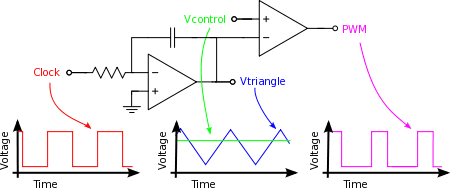
Industrial systems compare a triangle wave against a reference voltage. Where the reference is higher than the triangle → Output ON. Where lower → Output OFF. This method is common in power converters and SMPS.
Important Parameters Associated with PWM
To properly design PWM systems, you must understand these key parameters:
- 1Duty Cycle — ON time percentage per cycle
- 2Frequency — How many cycles per second
- 3Resolution — How finely duty cycle can be adjusted (8-bit = 256 steps, 10-bit = 1024 steps)
- 4Rise Time — How fast signal goes from LOW to HIGH
- 5Fall Time — How fast signal goes from HIGH to LOW
- 6Switching Losses — Energy lost during switching transitions
Higher resolution = smoother control. 8-bit gives 256 steps, 10-bit gives 1024 steps of fine adjustment.
Types of PWM
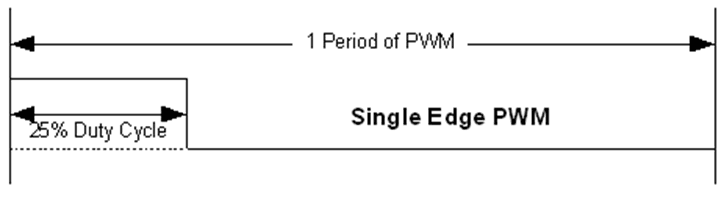
1. Single Edge PWM
A single pulse is produced at each switching cycle. The pulse always starts at the same point and only the width changes. Simple and easy to implement, though it may have higher harmonic content.
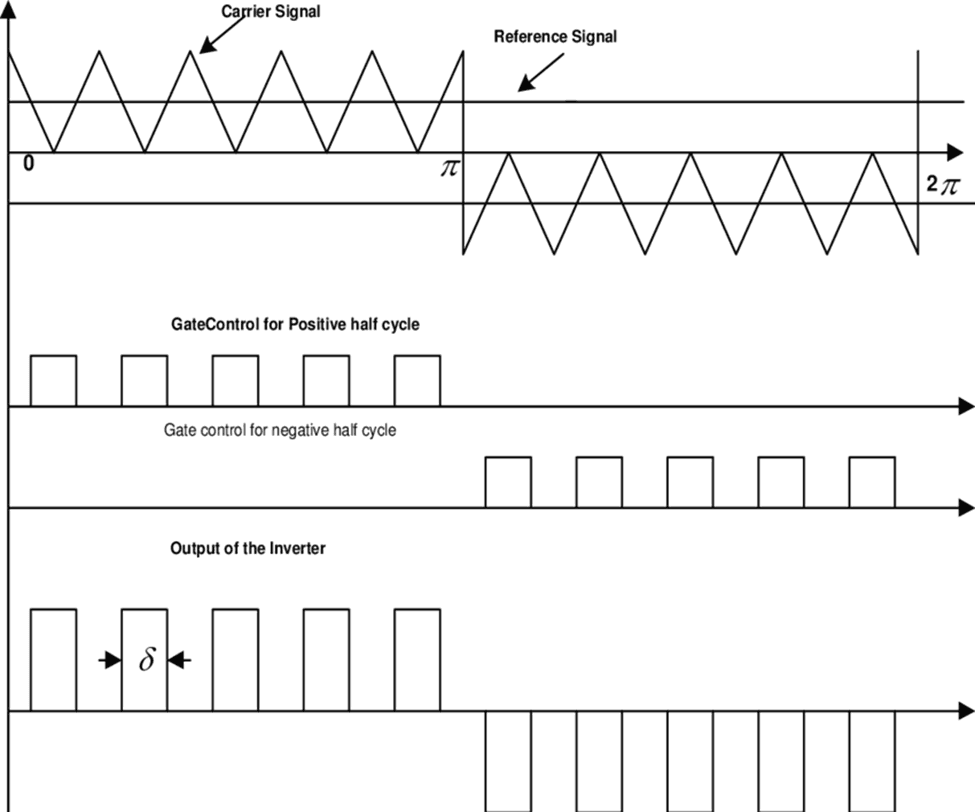
2. Multiple-Pulse Width Modulation (MPWM)
Multiple pulses are generated during each switching cycle. This method lowers harmonic distortion while raising the output waveform's general quality. Two-level and three-level MPWM are frequently used in high-power applications.
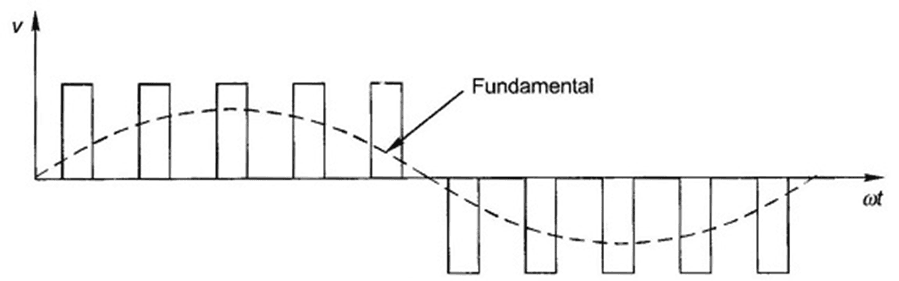
3. Sinusoidal PWM (SPWM)
Sinusoidal PWM alters pulse width to resemble a sinusoidal waveform. It uses a sine wave reference to minimize harmonic distortion and yield a smoother output. Commonly used in inverters and motor control systems where high output quality is critical.
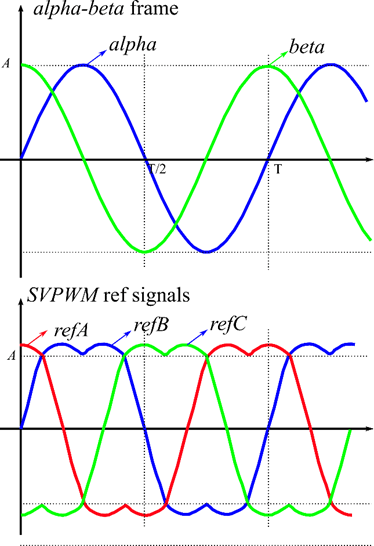
4. Space Vector PWM (SVPWM)
Space Vector PWM (SVPWM) is an advanced digital modulation algorithm used to control three-phase power inverters, most commonly for driving AC induction and permanent magnet synchronous motors (PMSM). It treats the inverter as a single unit to generate a rotating voltage vector with higher efficiency than standard methods.
Difference Between PWM and PPM
PWM = Control power. PPM = Encode information. In RC transmitters, PWM controls servo angle while PPM combines multiple channels into one signal.
Applications of PWM
PWM is everywhere in modern electronics:
1. Motor Speed Control
Used in DC motors, BLDC motors, and drones. ESC (Electronic Speed Controller) in drones uses PWM to control motor throttle.
2. LED Brightness Control
Instead of wasting power in resistors, PWM adjusts brightness efficiently. Used in displays, indicators, and lighting systems.
3. Switching Power Supplies (SMPS)
SMPS uses PWM to regulate output voltage precisely and efficiently.
4. Solar Charge Controllers
PWM controllers regulate battery charging from solar panels.
5. Audio Amplifiers (Class D)
PWM improves efficiency in Class D audio amplifiers significantly.
Advantages of PWM
- 1Very high efficiency
- 2Low power loss
- 3Precise control over output
- 4Digital friendly — easy to implement with microcontrollers
- 5Generates less heat
Because the transistor is either fully ON or fully OFF — it avoids energy waste in the mid-region, unlike linear regulators.
Disadvantages of PWM
- 1Generates electrical noise
- 2Requires filtering for smooth output
- 3EMI (Electromagnetic Interference) issues at high frequency
- 4Complex design in high-power systems
In sensitive applications, always add proper EMI filtering and shielding around PWM circuits to prevent interference with other components.
PWM Types at a Glance
Conclusion
PWM is not just a signal. It is a power control strategy that makes modern electronics efficient. From LED dimming to industrial motor drives, from Arduino hobby projects to drone flight controllers — PWM is the silent technology behind smooth control.
Once you master PWM, you unlock motor control, power electronics, embedded systems, robotics, and renewable energy systems. PWM is simple in idea — but powerful in application.
Key Takeaways
- 1⚡ PWM controls power by varying the ON-time (duty cycle) of a repeating signal
- 2📐 Duty Cycle = (ON time / Total Time) × 100 — controls average output voltage
- 3🔁 Frequency determines how many cycles per second — higher = smoother output
- 4🔧 Generated using 555 Timer IC, microcontrollers (Arduino), or comparator circuits
- 5🆚 PWM vs PPM — PWM controls power, PPM encodes information for radio systems
- 6🚀 Applications — motor speed, LED brightness, SMPS, solar charging, Class D audio
- 7✅ High efficiency, low heat, precise control — but watch for EMI at high frequencies