
What Is Basic Electronic? A Beginner-Friendly Guide to Understanding the Foundation of Modern Technology
Introduction: Why Basic Electronic Matters Today
Look around you — your smartphone, laptop, Wi-Fi router, fan regulator, even your university lab equipment — everything works because of basic electronic principles. Before someone can design a robot, build an automatic incubator, or create a UPS system, they must first understand basic electronic fundamentals.
This article explains what basic electronic is, its history, analog and digital circuits, components, active and passive elements, electromechanical devices, advantages, disadvantages, and everything in a smooth and meaningful learning flow. This guide is written in simple language, but explained deeply — so even an engineering student can strengthen their fundamentals.
What Is Basic Electronic?
Basic electronic (also called basic electronics) is the study of how electrical energy is controlled, modified, and used through electronic components such as resistors, capacitors, diodes, and transistors.
To understand this definition, let's break it into small parts:
- 1Electrical energy → Energy created by the movement of electrons.
- 2Control → Changing voltage, current, or signal behavior.
- 3Electronic components → Small devices that guide or manipulate electricity.
Basic electronics is the science of controlling the flow of electrons to perform useful tasks like amplification, switching, communication, and automation.
Beginning of Electronics
Electronics began when scientists discovered that electricity could be controlled inside materials. The journey started with:
- 1The discovery of the electron by J. J. Thomson in 1897.
- 2The invention of the vacuum tube by John Ambrose Fleming in 1904.
- 3The invention of the transistor at Bell Labs in 1947.
The invention of the transistor changed everything. Before that, vacuum tubes were large, fragile, and consumed high power. Transistors made electronics small, reliable, and energy-efficient.
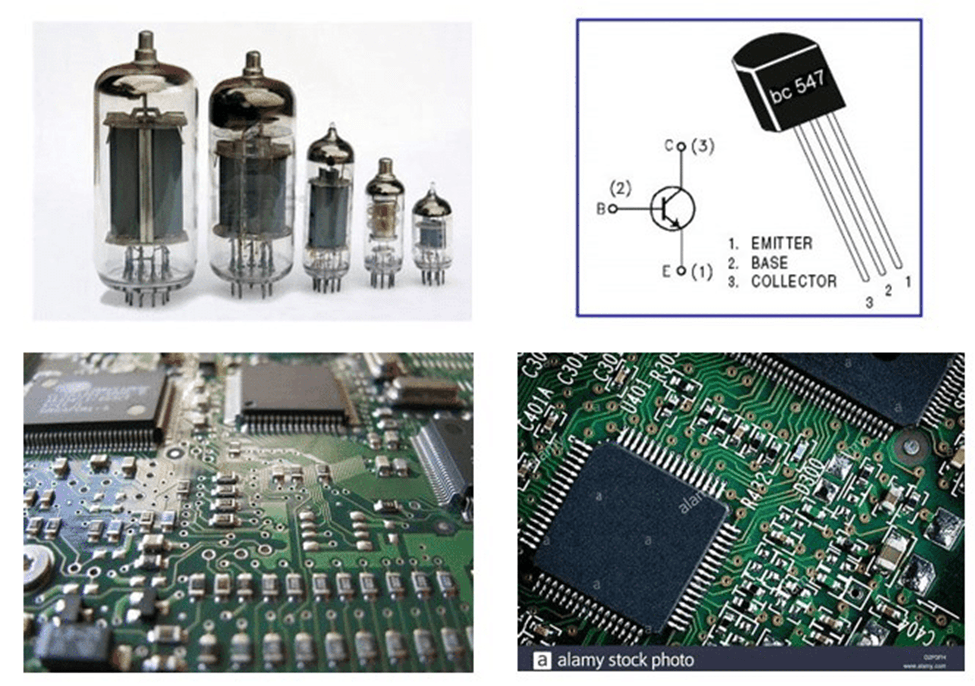
History of Basic Electronics (Short Timeline)
- 11904 — Vacuum diode invented.
- 21947 — Transistor invented.
- 31958 — Integrated circuit invented.
- 41971 — Microprocessor developed.
- 5Today — Nanoelectronics, IoT, AI chips.
Modern electronics evolved from simple diode circuits to microcontrollers like Arduino and advanced processors used in AI systems today.
Analog Circuit in Basic Electronics
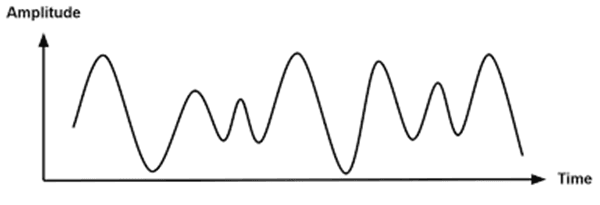
An analog circuit processes continuous signals. A continuous signal changes smoothly over time. For example:
- 1Microphone audio signal
- 2Temperature variation
- 3Light intensity
If voltage gradually increases from 1V to 5V smoothly, that is an analog signal.
Audio amplifier, Radio receiver, Power supply regulator.
Digital Circuit in Basic Electronics
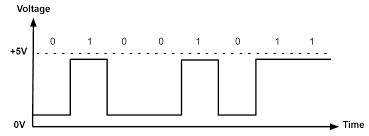
A digital circuit works with only two values:
- 10 (LOW) — 0 Volts
- 21 (HIGH) — 5 Volts
These values represent binary logic. Digital circuits use logic gates like AND, OR, and NOT.
Calculator, Computer, Microcontroller system (like Arduino).
Components Used in Basic Electronics
Every electronic circuit is made of components. These are divided into three main categories:
- 1Passive Components
- 2Active Components
- 3Electromechanical Devices
Passive Components
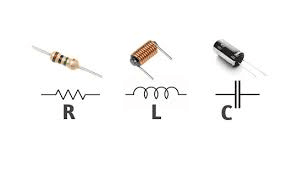
A passive component does not generate energy. It only consumes, stores, or releases energy. Passive components cannot amplify signals.
1. Resistor
A resistor limits current. Example: Fan regulator uses resistance to reduce speed.
2. Capacitor
A capacitor stores electrical energy temporarily. Example: Used in power supplies to remove ripple.
3. Inductor
An inductor stores energy in a magnetic field. Example: Used in filters and DC-DC converters.
Active Components
An active component requires external power and can amplify or control signals. Active components are the heart of modern electronics.
1. Diode
Allows current to flow in only one direction. Example: Used in rectifiers to convert AC to DC.
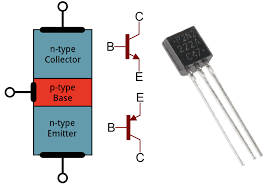
2. Transistor
Acts as a switch or amplifier. Example: Used in motor driver circuits.
3. Integrated Circuit (IC)
A small chip containing many transistors. Example: Timer IC (NE555), Op-amp IC (LM741).
Electromechanical Devices
Electromechanical devices combine electrical and mechanical movement. They are used in automation systems like automatic doors and incubators.
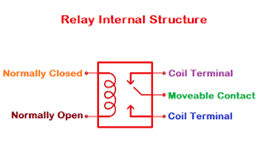
1. Relay
An electrically controlled switch — allows a low-power signal to control a high-power circuit.
2. Motor
Converts electrical energy into mechanical motion — used in fans, robots, and conveyor systems.
3. Solenoid
Converts electrical energy into linear motion — used in automatic locks and valves.
Advantages of Basic Electronics
- 1Small size and compact systems
- 2High efficiency
- 3Low power consumption
- 4Fast operation speed
- 5Automation capability
Electronics made communication, medical equipment, robotics, and computing possible.
Disadvantages of Basic Electronics
- 1Sensitive to voltage spikes
- 2Heat generation under load
- 3Complex troubleshooting
- 4Requires technical knowledge to design and repair
- 5Electronic waste problem
Understanding these disadvantages helps engineers design better protection systems like surge protectors, heat sinks, and proper grounding.
How All Topics Connect Together
When you learn basic electronics, you follow a natural progression:
- 1Understanding voltage, current, and resistance.
- 2Learning passive components (resistor, capacitor, inductor).
- 3Studying active components (diode, transistor, IC).
- 4Building analog circuits.
- 5Moving to digital circuits.
- 6Designing complete systems.
Everything in advanced electronics — robotics, automation, communication systems — is built on these basics.
Passive vs Active vs Electromechanical (Quick Comparison)
Analog vs Digital Circuit (Quick Comparison)
Conclusion
Basic electronic is not just a subject — it is the foundation of modern technology. If someone understands what a resistor does, how a transistor switches, and the difference between analog and digital signals, they can design real systems.
Whether you are an engineering student, hobbyist, or future innovator, mastering basic electronics fundamentals gives you the power to build and control the modern world.
Key Takeaways
- 1⚡ Basic electronics is the science of controlling electron flow for useful tasks
- 2📡 Analog circuits process smooth continuous signals — audio, temperature, light
- 3💻 Digital circuits work with binary logic — 0 and 1 only
- 4🔧 Passive components (resistor, capacitor, inductor) store or limit energy
- 5🔌 Active components (diode, transistor, IC) can amplify and switch signals
- 6⚙️ Electromechanical devices (relay, motor, solenoid) convert electricity to motion
- 7🚀 All advanced electronics — robotics, IoT, AI — is built on these fundamentals